Decor Paper Grammage Guide: 60gsm, 65gsm, 70gsm, 80gsm and 85gsm
Decor paper grammage is the mass of the paper per square metre, expressed as grams per square metre, or gsm. It is an important purchasing specification, but it is not a quality grade by itself. **A higher grammage does not automatically mean better opacity, better printing or a better finished panel.**
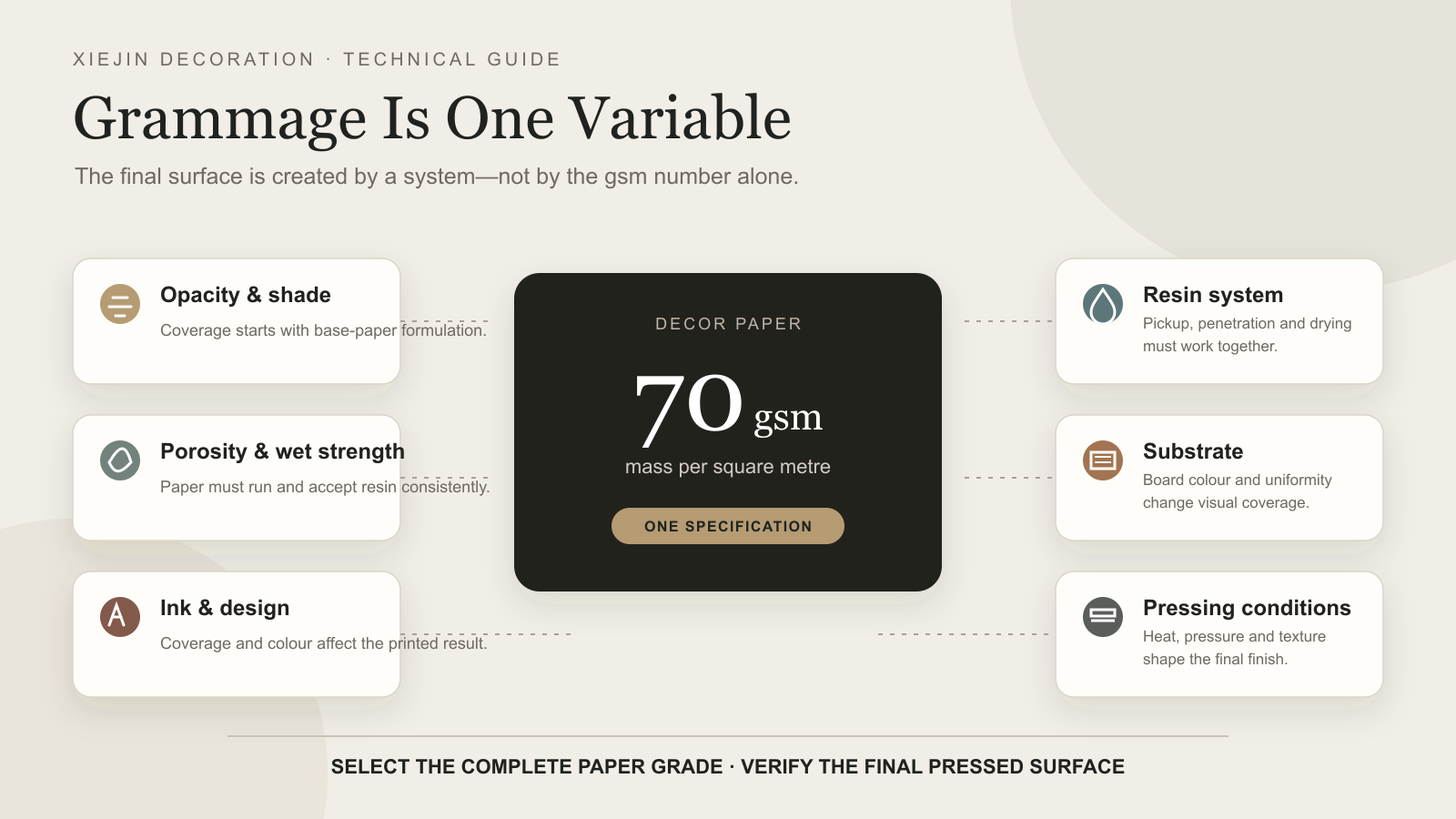
The correct choice depends on the complete surface system: base-paper formulation, opacity, porosity, wet strength, ink coverage, resin impregnation, substrate colour, pressing conditions and the required finished appearance. For this reason, 60gsm, 65gsm, 70gsm, 80gsm and 85gsm should be treated as starting options to test, not universal application rules.
What Does Decor Paper Grammage Mean?
Grammage tells you how many grams one square metre of paper weighs. A 70gsm paper therefore weighs 70 grams per square metre under the specified test conditions.
Grammage is related to paper structure, but it is not the same as thickness, bulk or opacity. Two papers with the same grammage may perform differently because their fibres, fillers, pigments, surface treatment, porosity and manufacturing process are different. In the same way, two papers with different grammages can sometimes achieve similar visual coverage if their base-paper formulations are designed differently.
Leading decor base-paper manufacturers describe a wide range of basis weights rather than one mandatory industry standard. They also list printability, ink absorption, dimensional stability, strength and resin penetration as separate performance properties.[^1][^2] This is why a buyer should evaluate the complete paper grade, not the gsm number alone.
Why Does Grammage Matter in Decorative Paper?
1. Opacity and substrate coverage
Grammage can influence how well the decorative layer covers the colour and visual variation of MDF, HDF, particleboard or other substrates. However, opacity also depends strongly on pigments, fillers and the formulation of the base paper. A heavier paper with unsuitable opacity may still show the substrate, while a well-designed lighter grade can perform effectively on a uniform board.
2. Printing and colour development
Paper structure affects how gravure ink transfers, absorbs and dries. The final result depends on surface smoothness, absorbency, shade and dimensional stability as well as grammage. Buyers should compare the same design on candidate papers rather than assuming that a higher gsm will automatically produce richer colour.
3. Resin impregnation
Decor paper must accept and distribute the selected resin system consistently. Grammage can affect the amount of material passing through the impregnation line, but resin pickup and penetration are also controlled by paper porosity, absorbency, resin formulation, line speed and drying conditions.[^3] A change in gsm may therefore require the impregnation process to be adjusted.
4. Handling and production stability
Paper strength, moisture, dimensional stability and roll quality influence printing and impregnation runnability. Higher grammage may provide more handling margin in some systems, but wet strength and paper construction remain essential. Trial performance on the customer’s actual equipment is more useful than judging by weight alone.
5. Material and processing cost
For the same surface area, a higher-gsm paper uses more paper mass. It may also change resin consumption and drying requirements, depending on the grade and process. The most economical specification is therefore the lightest qualified system that reliably meets appearance, processing and finished-panel requirements—not simply the lowest or highest gsm available.
Comparing 60gsm, 65gsm, 70gsm, 80gsm and 85gsm Decor Paper
The following comparison is a practical screening guide. Actual suitability must be confirmed with the selected base-paper grade, design, substrate, resin system and press.
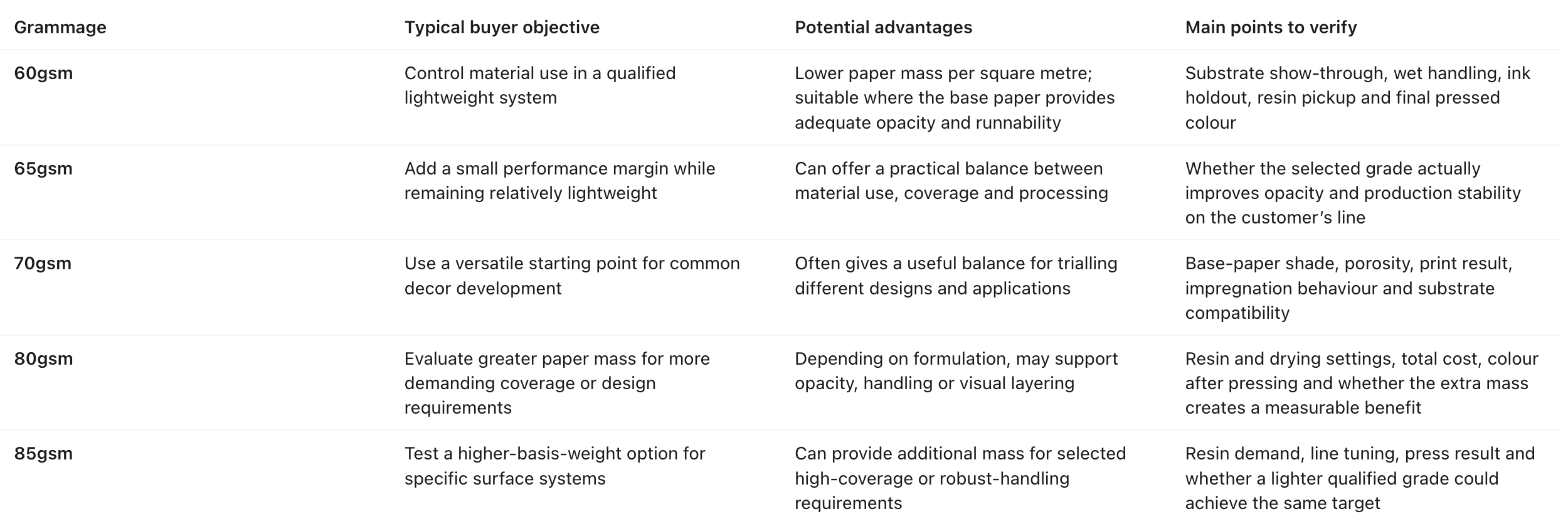
This table does not mean that 60gsm is “low quality” or 85gsm is “high quality.” The best paper is the one that produces a stable, approved surface at the required cost on the buyer’s actual production line.
How Should Grammage Be Selected for Different Applications?
Laminate flooring
For laminate flooring, evaluate the printed design after impregnation and pressing with the intended HDF, overlay, texture and production conditions. The paper must support colour consistency, resin processing and the required visual coverage.
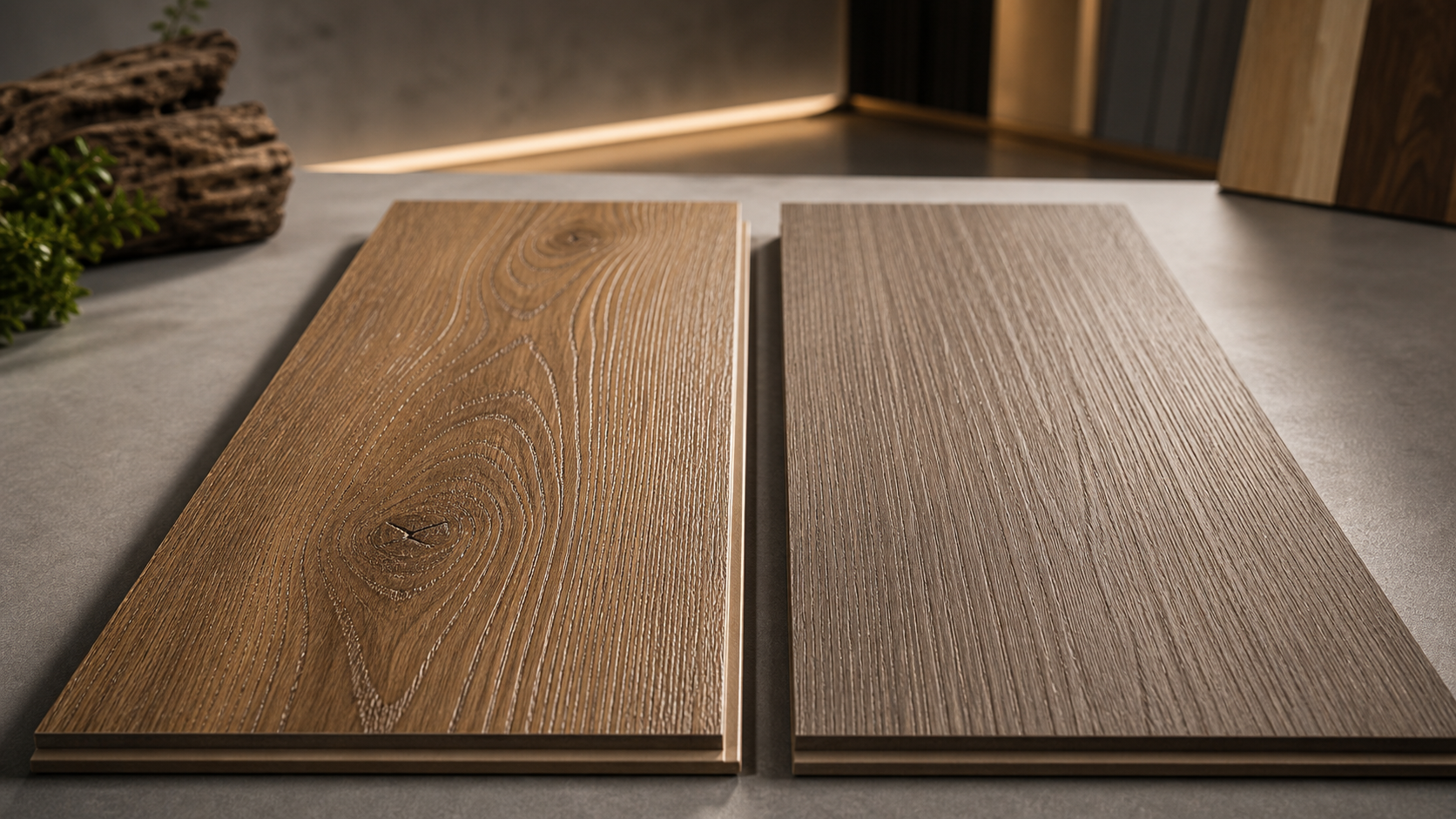
For synchronized embossed flooring, realism comes primarily from accurate coordination between the printed grain and the embossing plate. A higher paper grammage does not create EIR by itself.
Read [EIR vs Non-Synchronized Embossing in Laminate Flooring]
Furniture panels, MDF, HDF and particleboard
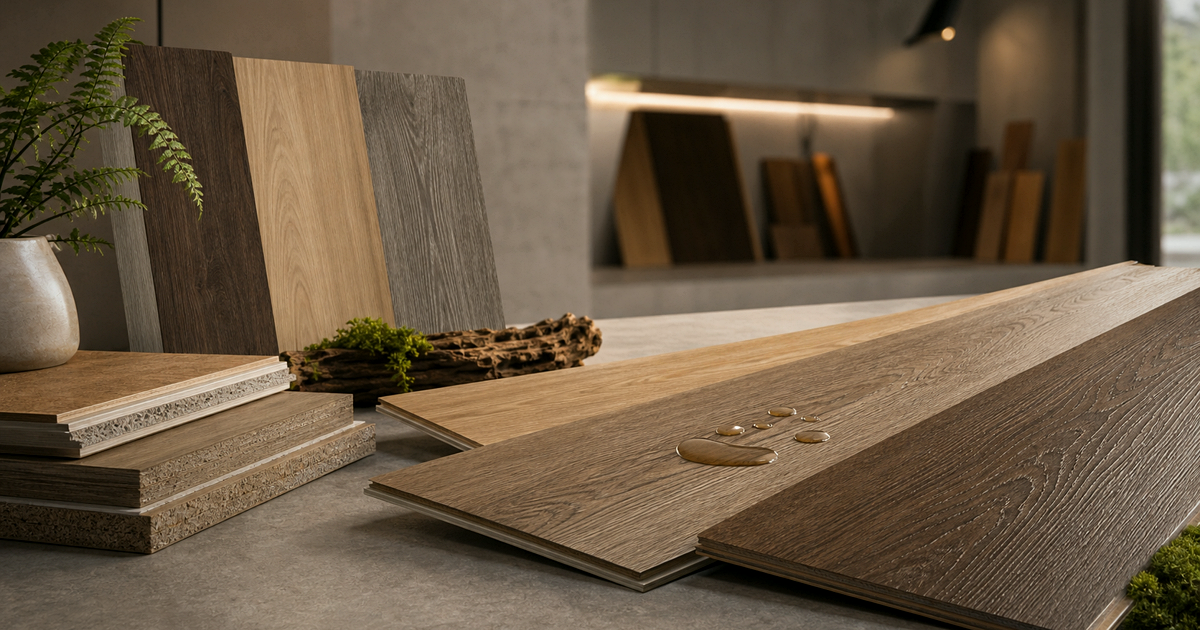
Board colour and surface uniformity are important. A dark or inconsistent substrate may require stronger opacity, but the solution may involve base-paper formulation, background colour, ink coverage or substrate control—not only a higher gsm. The final decision should be based on the pressed furniture-panel sample.
TFL, LPL and HPL systems
The paper specification must match the impregnation and pressing system. Porosity, resin penetration, drying behaviour and dimensional stability should be checked together. Buyers should also clarify whether they require [printed decor paper or melamine impregnated paper], because these are different production stages.
Light, dark and high-contrast designs
A dark woodgrain or high-contrast pattern does not automatically require 80gsm or 85gsm. Ink coverage, base-paper shade, opacity and the colour of the final substrate can be equally important. Test the actual design rather than selecting paper weight from the artwork category alone.
Is Higher-Grammage Decor Paper Better?
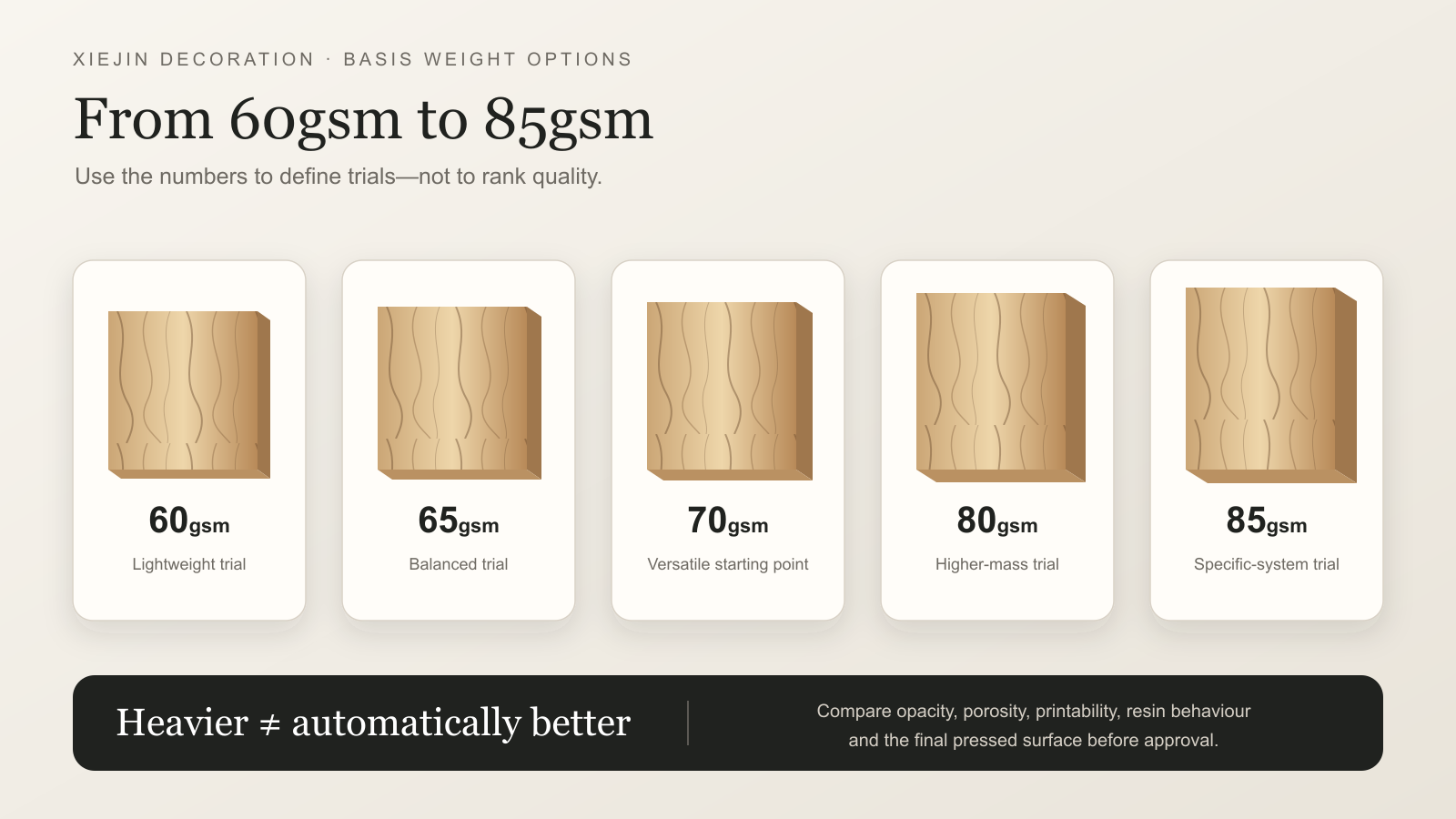
Not necessarily. A heavier paper may be useful when a specific grade provides the required opacity, handling or processing margin. It may be unnecessary when a lighter paper already meets the final specification.
Increasing grammage without rechecking the production system may also change:
- paper cost per square metre;
- resin pickup and penetration;
- drying behaviour and line settings;
- the way colour appears after impregnation and pressing;
- roll weight, handling and production yield.
The correct question is not “Which gsm is best?” but “Which complete paper specification produces the approved finished surface most consistently?”
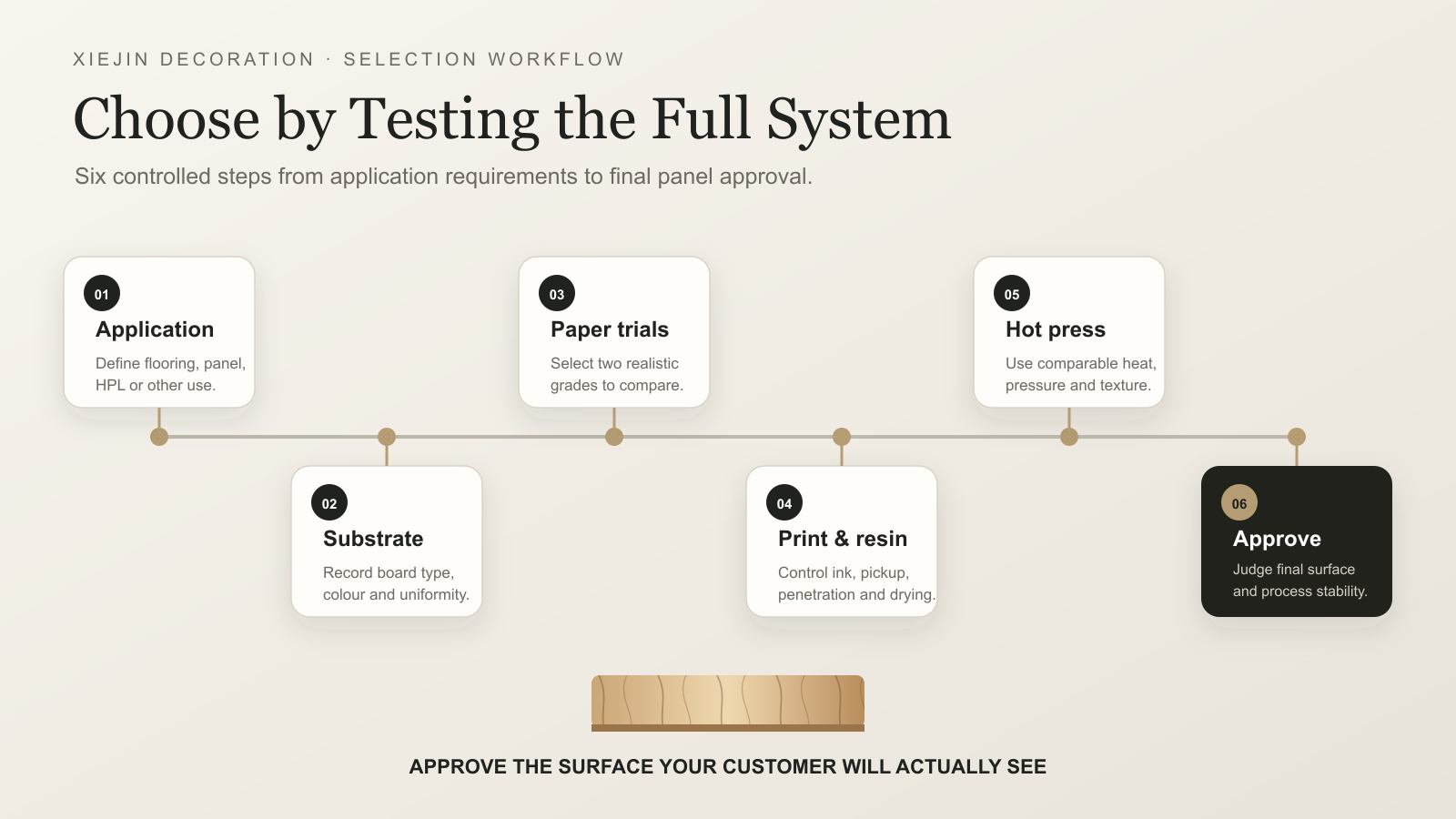
A Practical Grammage Selection and Testing Process
1. Define the final application.** Confirm whether the paper will be used for flooring, furniture panels, HPL, wall panels, cabinetry or another surface.
2. Identify the substrate and production system.** Record board type, board colour, impregnation arrangement, resin system, overlay and pressing conditions.
3. Select two realistic paper candidates.** Compare nearby grammages or different base-paper grades instead of testing only one assumption.
4. Print the same design under controlled conditions.** Compare colour, ink transfer, visual depth and repeat consistency.
5. Impregnate and press comparable samples.** Keep the relevant process conditions controlled and record any setting changes required by each paper.
6. Inspect the final surface.** Check opacity, pressed colour, tonal layering, defects, resin behaviour, texture and production stability.
7. Approve both process and visual standards.** Retain an approved printed-paper reference and an approved pressed-panel reference for repeat orders.
What Should a Buyer Include in an RFQ?
To receive a useful paper recommendation and quotation, provide:
- final application and target market;
- substrate type, colour and surface condition;
- current or preferred grammage and base-paper grade;
- whether the paper will be impregnated in-house or by a partner;
- resin system and relevant impregnation conditions, if known;
- required roll width and order format;
- target design, colour reference or physical sample;
- overlay, gloss, texture or EIR requirement;
- annual or monthly estimated volume;
- acceptance standard for the final pressed surface.
This information allows the supplier to narrow the trial options and reduces sampling based on incomplete assumptions.
How Xiejin Decoration Supports Grammage and Colour Trials
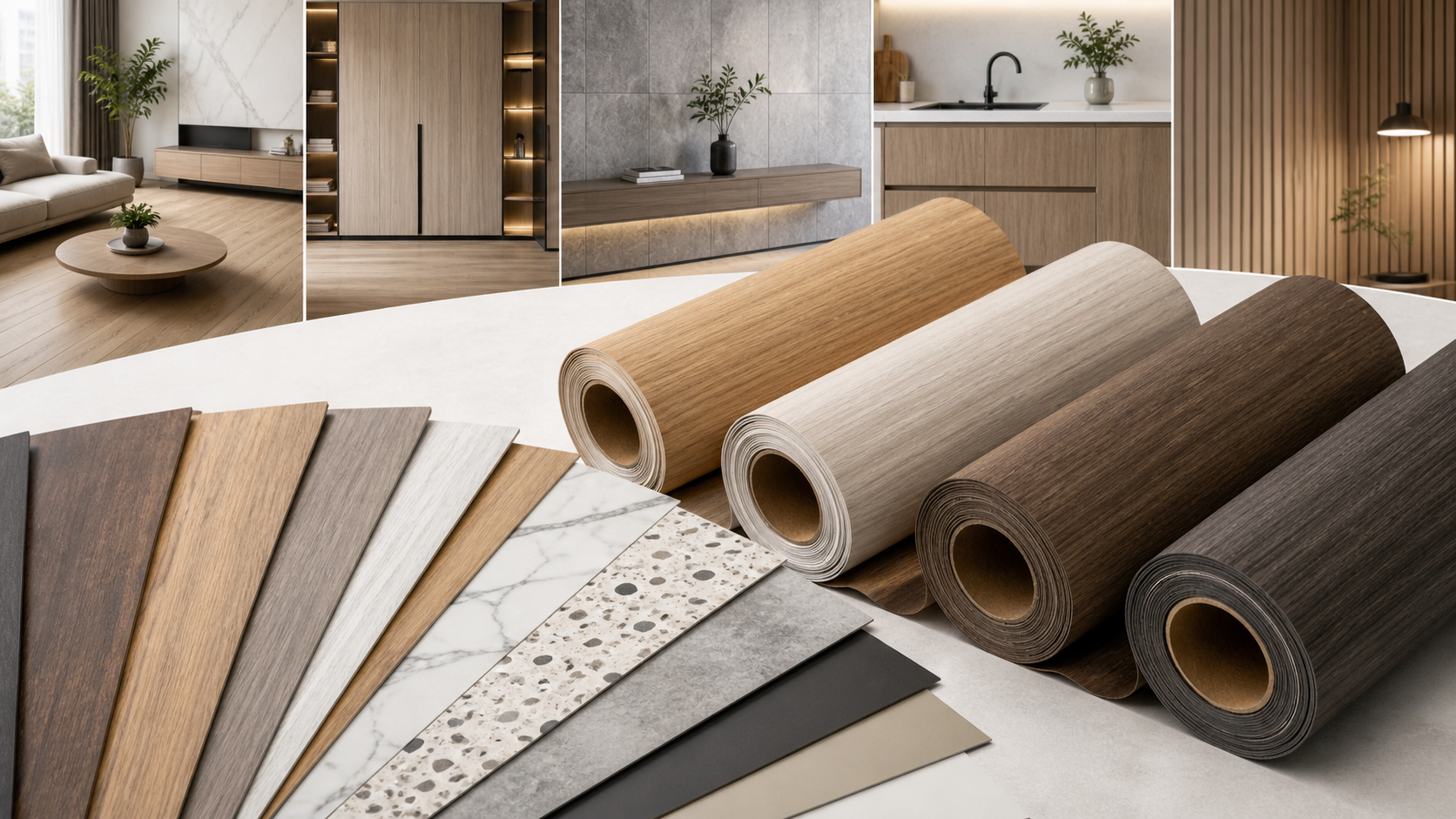
Established in 2013, Xiejin Decoration specializes in decorative printing paper for downstream impregnation and lamination. We can discuss 60gsm, 65gsm, 70gsm, 80gsm and 85gsm options according to the customer’s design, substrate and production target, then support sample-based colour matching and controlled trial printing.
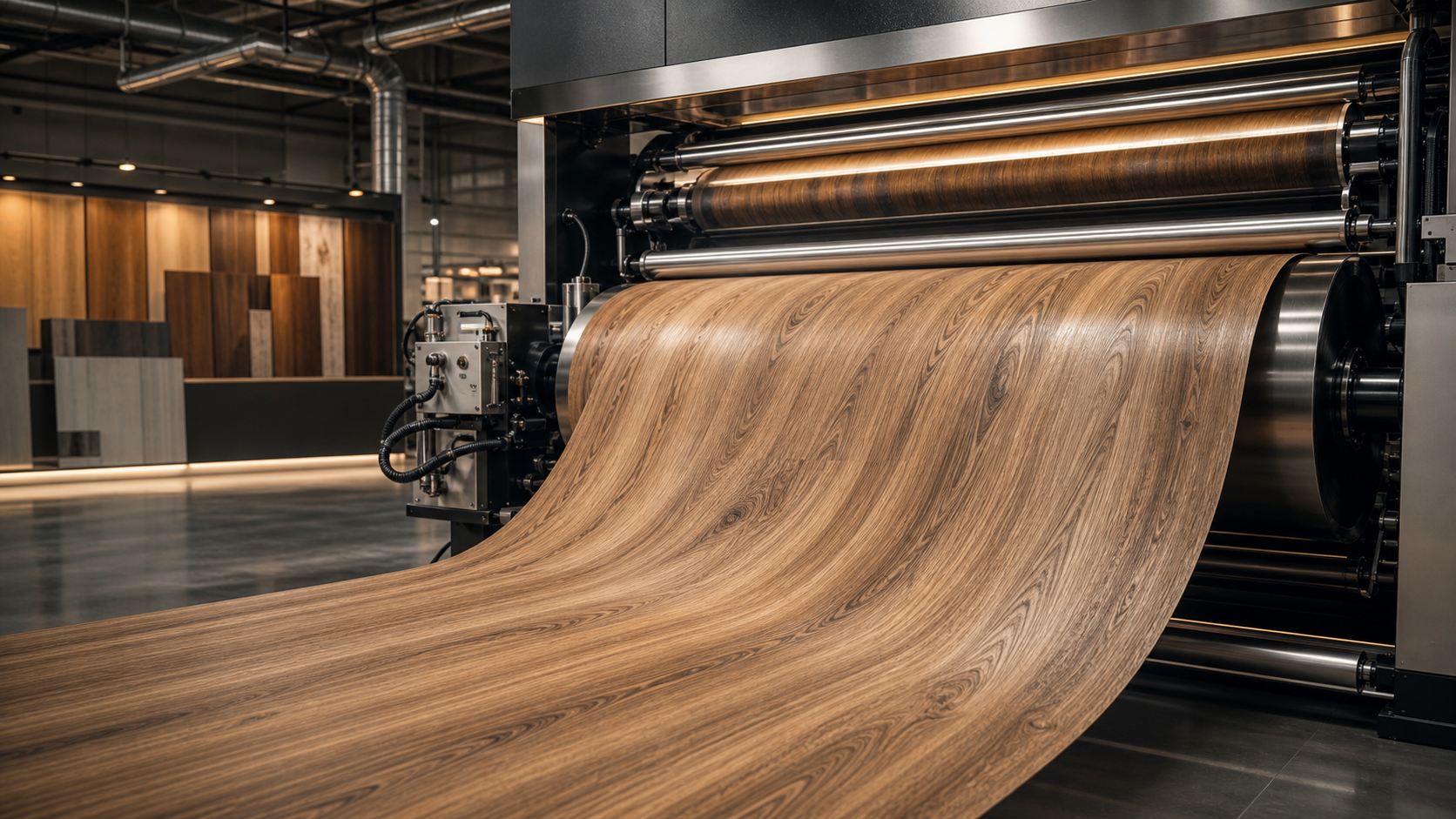
Our work focuses on the visible result after lamination: realistic woodgrain development, tonal depth, colour control and repeatable production. Buyers can compare candidate papers with the intended design and approve the option that performs best in their own surface system.
Our printing range covers cylinder circumferences from **1230mm to 3046mm** and widths up to **1275mm**, supporting flexible decor development and longer, more natural pattern repeats.
Read [Why Large-Repeat Printing Matters for Decor Paper]
Explore our [printed decor paper collections]
Frequently Asked Questions
Is higher-gsm decor paper always better?
No. Higher grammage means more paper mass per square metre, not automatically better opacity, printability or finished-panel quality. The paper formulation and the complete impregnation and pressing system must be evaluated together.
Is grammage the same as paper thickness?
No. Grammage measures mass per unit area. Thickness depends on paper density, fibre structure, fillers, calendering and other manufacturing factors. Two papers with the same gsm can have different thicknesses and performance.
Which grammage should be used for MDF or particleboard?
There is no single universal gsm. Selection depends on substrate colour and uniformity, required opacity, design, base-paper grade, resin system and press conditions. Compare candidate papers on the actual board before approving mass production.
Does EIR flooring require 80gsm or 85gsm paper?
Not automatically. EIR depends on the registration between the printed pattern and the synchronized embossing structure. The paper must still meet printing, impregnation and pressing requirements, but grammage alone does not create the synchronized effect.
Should colour be approved on the printed roll or the pressed panel?
Both references are useful for process control, but the final pressed panel should be the main appearance standard for a laminated product. Resin, substrate, heat, pressure, overlay and texture can all affect the final colour.
Request a Grammage and Colour-Matching Trial
Send us your final application, substrate, current paper specification, target design or physical sample, and relevant impregnation and pressing information. We can help you select suitable trial options and prepare printed decor paper samples for evaluation.
[View our decor paper collections] or [contact Xiejin Decoration] to discuss your project.